
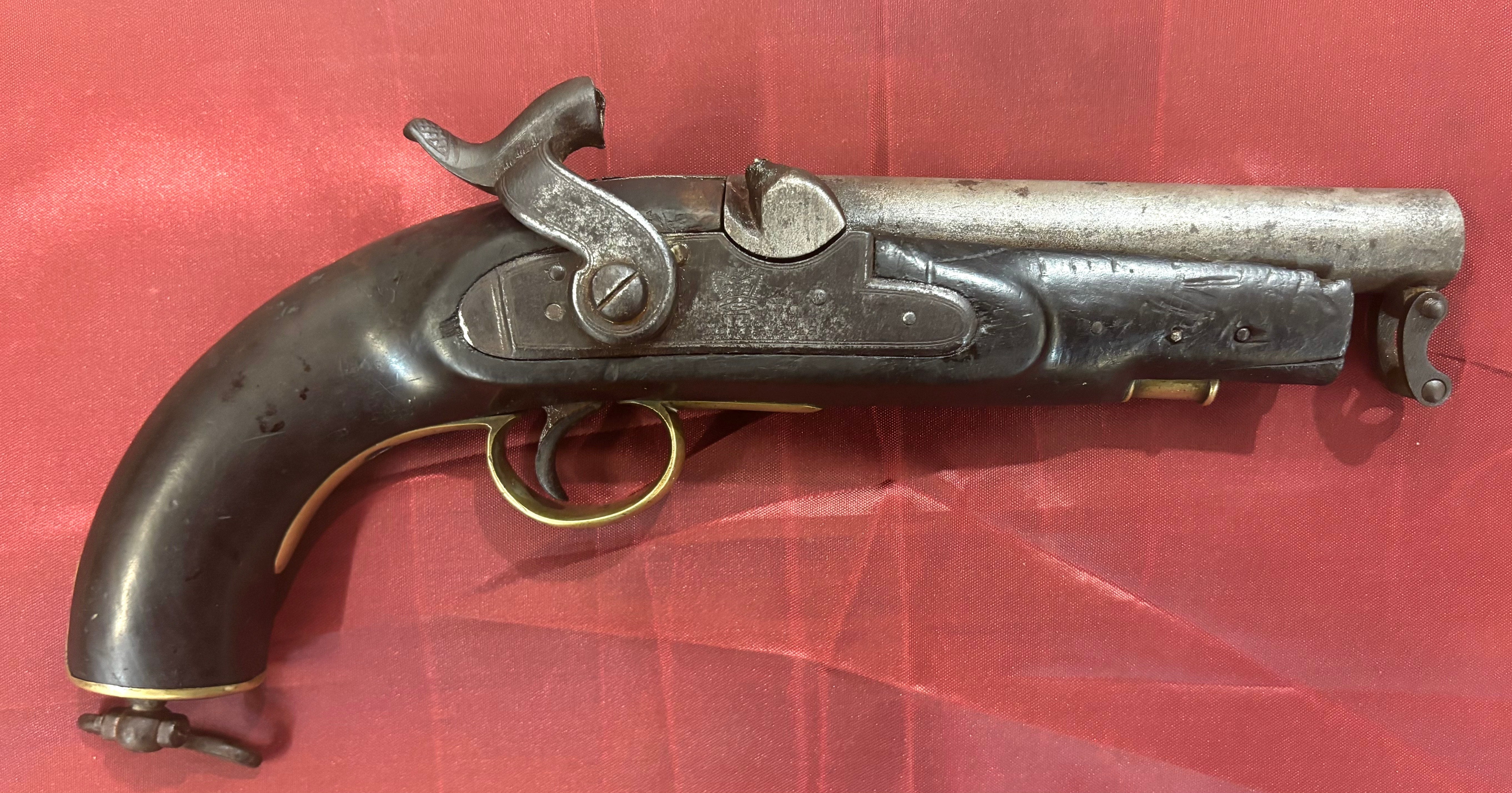
Tower Calvary Pistoleer Pistol
Happy Firearm Friday, readers!

For this week’s Firearm Friday, we’re traveling back to the 18th century to explore a classic cavalry sidearm — the Tower Pistol, specifically crafted for the Pistoleer (Indian Pattern). The example in our collection bears proof marks dating back to 1713.

Who were the Pistoleers?
A pistoleer was a mounted soldier skilled in the use of pistols, or more broadly, anyone armed with such a weapon. The term originates from the French word pistolier, meaning an expert marksman.

The earliest pistoleers were the mounted German Reiters, soldiers armed with advanced single-shot, muzzle-loading wheel-lock or Snaphance horse pistols. These fighters were formidable against heavy cavalry but gradually declined in prominence during the Thirty Years’ War. Afterwards, most Western cavalry relied on swords or lances as their main weapons, though pistols remained a common sidearm.

Evolution Through the Ages
During the English Civil War, both the Roundhead Ironside cavalry and the Cavaliers wielded pairs of flintlock pistols, with Cavaliers often favoring ornate designs, including early breechloaders with detachable barrels.

Before 1700, cavalrymen, typically recruited from the wealthy gentry, purchased their own nonstandard pistols. The Industrial Revolution changed this dynamic, allowing mass production of standardized firearms with interchangeable parts. Despite this, British Army and Royal Navy officers continued to commission bespoke pistols from renowned London gunsmiths such as Joseph Manton, Robert Wogdon, Henry Nock, and Durs Egg well into the mid-19th century.

The Role of Horse Pistols
Early modern light cavalry carried sabres alongside large-caliber, single-shot horse pistols, also known as holster pistols. Widely used by British and French forces during the Napoleonic Wars, these pistols were devastating at close range and moderately effective at medium distances when fired en masse. Common calibers included .71, .65, and .58 (as seen in our featured pistol), enabling compatibility with standard infantry musket balls.

During the early Victorian era, many existing horse pistols were converted to caplock ignition systems. They remained in service until the arrival of revolvers like the Colt Dragoon (1847) and the Adams revolver (1851).

Tower of London Manufacturing
Horse pistols manufactured at the Tower of London used the same lock mechanism as the famous Brown Bess musket. Models produced before 1790 had wooden ramrods instead of steel. The locks were stamped with the crown of George III, while the barrels bore arrow proof marks.

British light cavalry units, such as the hussars, were trained to fire both pistols before charging with sabres during the Napoleonic Wars. Dragoons carried a brace of pistols as secondary arms to their carbines. Beyond the battlefield, these weapons were also issued to staff officers, coast guard, customs officers, and mounted police. Unauthorized use by color sergeants was also common.

Naval and Indian Variants
The Sea Service pistol, a naval counterpart, featured brass barrels to resist corrosion, belt hooks, and brass butt caps for close combat. Infamously, the pirate Blackbeard carried seven of these pistols at once.

The Indian Pattern — an improved version of the .71 Tower horse pistol — was produced in British India between 1787 and 1832 for officers of the East India Company and British Indian Cavalry. Later models included captive ramrods, waterproof frizzens for monsoon conditions, and lanyard attachments, innovations that were later adapted to other models like the Tower Model 1835 and 1840.

Indian-made horse pistols in .65 and later .577 caliber, manufactured at arsenals such as Lucknow, remained in use until 1856 and were popular among big-game hunters prior to the invention of the double-barreled howdah pistol. These pistols were also exported to England and saw action during the late Napoleonic Wars. Caplock-converted, rifled versions of the Indian Pattern were even used by both British troops and rebel sepoys during the Indian Mutiny.

Our Featured Pistol
The Tower Pistol in our collection was originally produced in 1713 as a naval-issue firearm and was later retrofitted in the 1887s to match the New Land Pattern specifications.

This remarkable piece of history is now proudly displayed in our pistol case for all to see.
Related Posts

Heckler & Koch 630

Smith & Wesson Model 52

Evans Carbine Rifle

THE BROWNING AUTO-5: A SHOTGUN, A WEDDING & OUR VERY OWN BONNIE AND CLYDE.

Winchester 73 "The Daisy Rifle"

London Small Arms NO1

Freedom Arms Model 83


