
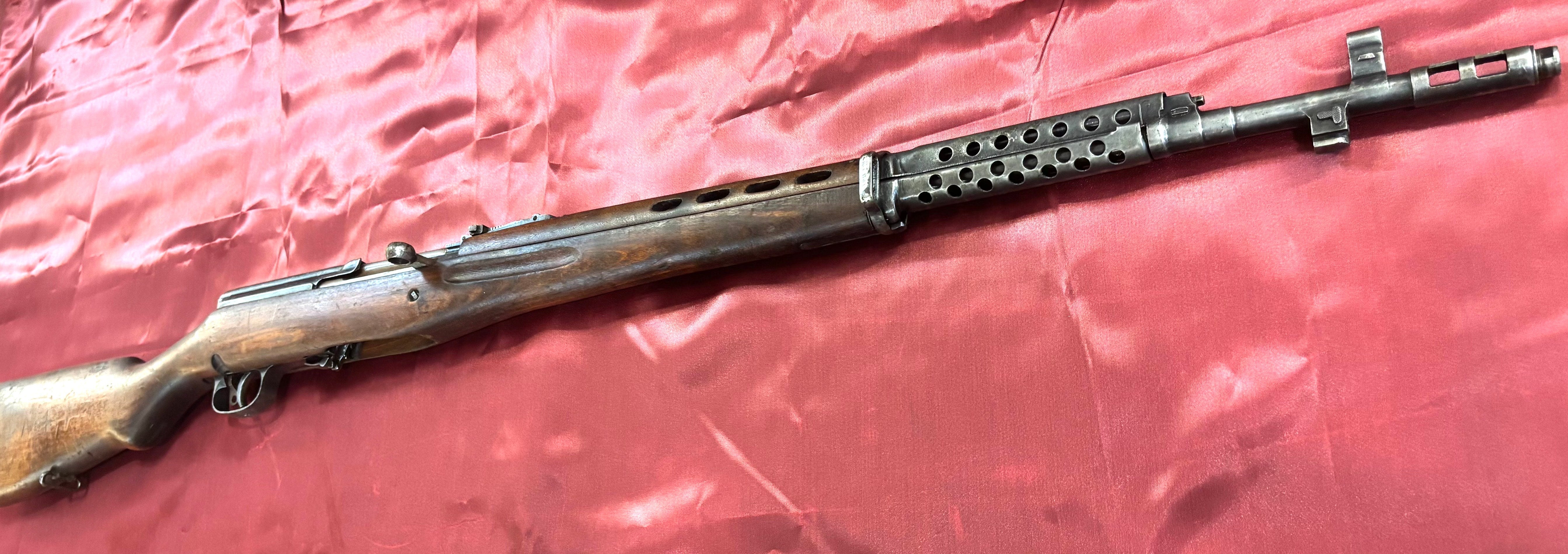
Soviet Tokarev SVT-40
This week for Firearm Friday we are bringing you the Soviet SVT-40 battle rifle.

The SVT-40 Tokarev self-loading rifle, model of 1940 is a Soviet semi-automatic battle rifle that saw widespread service during and after World War II. It was intended to be the new service rifle of the Soviet Red Army, but its production was disrupted by the German invasion in 1941, resulting in a change back to the Mosin–Nagant rifle for the duration of World War II although both rifles served concurrently.

https://owenguns.com/blogs/museum-weapons/the-russian-mosin-nagant
In the early 1930s, the Soviet Union requested the development of a semi-automatic rifle to replace the Mosin-Nagant. The design was left up to two individuals, Sergei Simonov and Fedor Tokarev. Simonov, who had experience in developing the Fedorov Avtomat, created a prototype for the AVS-36 in 1931. The rifle was used during the Winter War but was removed from service in 1941 due to design flaws.

In 1938, Tokarev's rifle was accepted for production, under the designation SVT-38 with hopes that it would become the new standard-issue rifle of the Red Army. Production began at Tula Arsenal in July 1939.

The SVT-38 is a gas-operated rifle with a short-stroke, spring-loaded piston above the barrel and a tilting bolt. The SVT-38 was equipped with a bayonet and a 10-round detachable magazine. The receiver was open-top, which enabled reloading of the magazine using five-round Mosin–Nagant stripper clips.

The SVT-38 saw its combat debut in the 1939–1940 Winter War with Finland. The rifle had many design flaws, as its gas port was prone to fouling, the magazine would sometimes fall out during use, and it was inaccurate, only being effective up to 600m. Production of the SVT-38 was terminated in April 1940 after some 150,000 examples had been manufactured.

With the removal of the SVT-38 from service, an improved design, the SVT-40, entered production. It was a more refined, lighter design incorporating a folding magazine release and lightening cuts. The hand guard was now of one-piece construction and the cleaning rod was housed under the barrel. Other changes were made to simplify manufacturing. Production of the Mosin–Nagant M1891/30 bolt-action rifle continued, and it remained the standard-issue rifle to Red Army troops, with the SVT-40 more often issued to non-commissioned officers and elite units like the naval infantry. Since these factories already had experience manufacturing the SVT-38, output increased quickly and an estimated 70,000 SVT-40s were produced in 1940.

By the time of Operation Barbarossa, the German invasion of the USSR in June 1941, the SVT-40 was already in widespread use by the Red Army. The first months of the war were disastrous for the Soviet Union; they lost hundreds of thousands of SVT-40s. To make up for this, the production of the Mosin–Nagant rifles was reintroduced. In contrast, the SVT was more difficult to manufacture, and troops with only rudimentary training had difficulty maintaining it. Submachine guns like the PPSh-41 had proven their value as simple, cheap, and effective weapons to supplement infantry firepower. This led to a gradual decline in SVT production. In 1941, over one million SVTs were produced but in 1942 Izhevsk arsenal was ordered to cease SVT production and switch back to the Mosin–Nagant 91/30. Only 264,000 SVTs were manufactured in 1942 and production continued to diminish until the order to cease production was finally given in January 1945. Total production of the SVT-38/40 was around 1,600,000 rifles, of which 51,710 were the SVT-40 sniper variant.

SVTs frequently suffered from vertical shot dispersion; the army reported that the rifles were of "flimsy construction and there were difficulties experienced in their repair and maintenance". The stock, made of Arctic Birch, was prone to cracking in the wrist from recoil. This was generally remedied by drilling and inserting one or two large industrial bolts horizontally into the stock just before the wrist meets the receiver.

The first country outside the Soviet Union to employ the SVT was Finland, which captured some 2,700 SVT-38s during the Winter War, and over 15,000 SVTs during the Continuation War. The SVT saw extensive use in Finnish hands. The Finns even attempted to make their own clone of the SVT-38 designated Tapako, though only a prototype was ever conceived. The Finns would continue to experiment with producing their own SVT based rifles until the late 1950s.

Germany captured several hundred thousand SVTs from the Eastern Front. As the Germans were short of self-loading rifles themselves, SVT-38 and 40s, designated respectively as Selbstladegewehr 258 and Selbstladegewehr 259 by the Wehrmacht, saw widespread use by Germany. The study of the SVT's gas-operated action also aided in the development of the German Gewehr 43 rifle.


Related Posts

P. BERETTA GARDONE VT 22LR Rifle

Alexander & Richards 14 Bore ML Shotgun

Alexander Henry Sealing Rifle

Colt M1902 32ACP Pistol

MG08/15 Maschinengewehr 08

AMT Hardballer Longslide

BRNO Mod 2


