
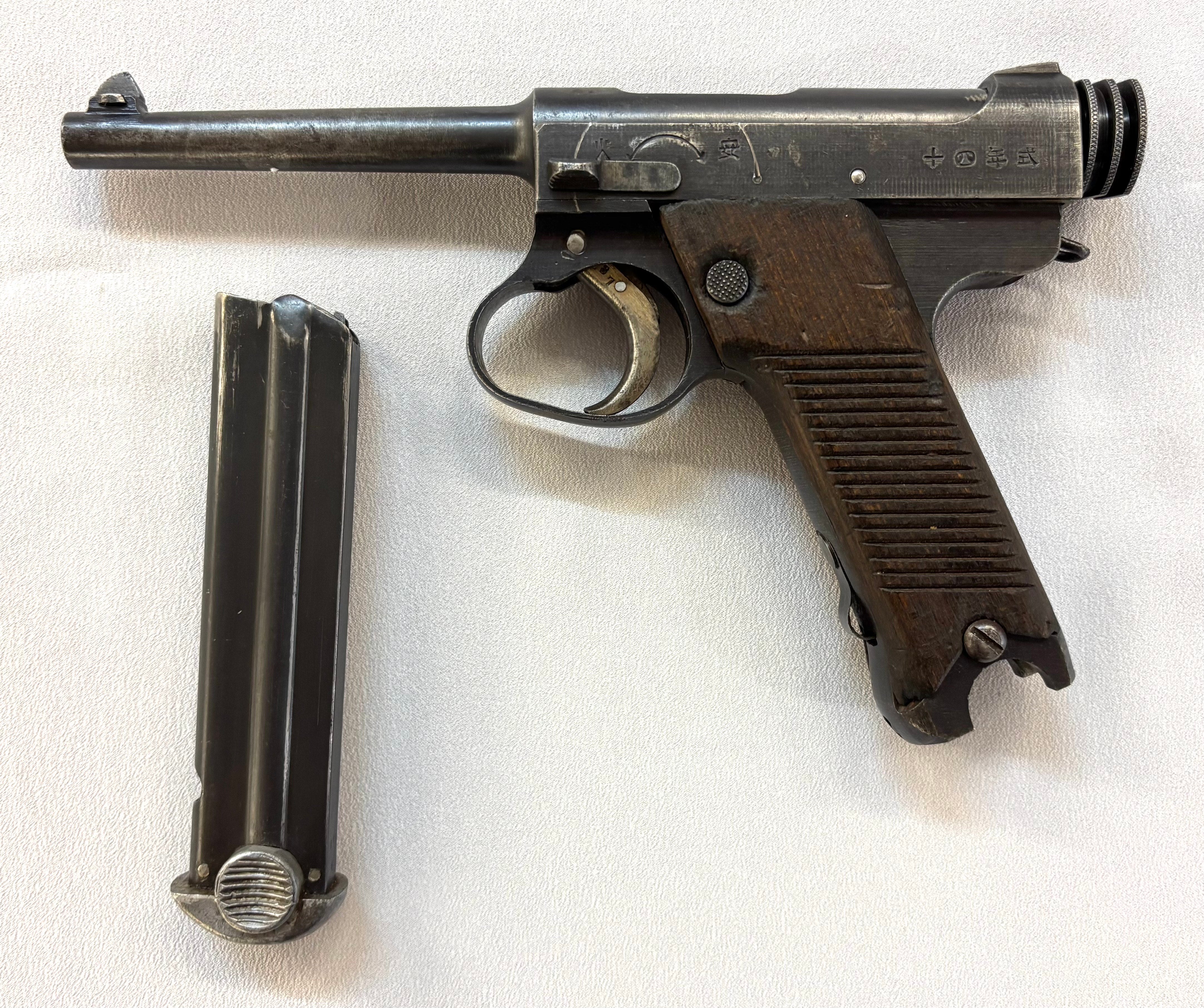
Type 14 Nambu Pistol
This week for Firearm Friday, it's time to talk about the one in the middle!, the interesting and unique Nambu pistol

The Nambu pistols are a series of semi-automatic handguns developed by the Japanese Koishikawa Arsenal, later known as the Tokyo Artillery Arsenal. The series includes three primary variants: the Type A, Type B, and the most widely produced, the Type 14. These pistols were intended to replace the older Type 26 revolver as Japan’s standard sidearm.
Designed by Kijirō Nambu, the pistols were widely used by Japanese forces during both the Second Sino-Japanese War and the Pacific War. The Type 14 variant became the most common, primarily issued to officers who were typically required to purchase their own sidearms.

Mechanically, the Nambu is a recoil-operated, locked-breech semi-automatic pistol. Both the Type A and Type 14 variants feature eight-round magazines, while the Type B holds seven rounds. A major drawback of the Nambu design was the difficulty in ejecting an empty magazine—the safety and magazine release mechanisms did not allow the magazine to drop freely. Users had to manually overcome the resistance of both the recoil and leaf springs, complicating reloads. This issue led to the removal of the magazine catch in the Type 14. Another design flaw was the placement of the safety lever above the trigger guard, making it nearly impossible to operate with the shooting hand.

The pistol’s grip is steeply angled, making magazine insertion finicky. The magazine spring operates at only about 60% efficiency, and friction from the cartridges against the magazine walls further reduces feeding reliability. Additionally, the ammunition had to meet strict dimensional standards, as soft point or cast lead bullets often failed to chamber correctly.

Chambered in the 8×22mm Nambu cartridge, the pistol was significantly underpowered compared to its contemporaries. The round’s muzzle energy was less than half that of the 9mm Parabellum and the 7.62×25mm Tokarev.

Before the Nambu was introduced, the only sidearm in Japanese military service was the Type 26 revolver. However, the global rise of semi-automatic pistol designs in the late 19th century, particularly the influential Mauser C96—which shared a similar locking system—inspired the development of Japan’s own modern sidearm. The Nambu’s design followed a Japanese military delegation’s report on European arms technology.

The first version, the Type A, was completed in 1902. Though never officially adopted, some units were exported to China and Siam. The Type B found service with the Imperial Japanese Navy and the Royal Thai Army in the 1920s. The Type 14, introduced in 1926 (the 14th year of the Taishō era), became the standard sidearm for the Imperial Japanese Army until the end of World War II in 1945. More than a weapon, the Nambu pistol often served as a symbol of rank and prestige—frequently carried in ornate holsters.

Japan manufactured approximately 400,000 Nambu pistols during the war, in contrast to the over one million M1911 pistols produced by the United States. After the war, many American servicemen brought Nambu pistols home as souvenirs, much like other Japanese weapons such as the guntō sword and the Arisaka rifle.

We have a Nambu displayed in our museum, it's in the middle of our pistol display and its the one that never wants to stay in its place. It's prone to a fall over.


Related Posts

Heckler & Koch 630

Smith & Wesson Model 52

Evans Carbine Rifle

THE BROWNING AUTO-5: A SHOTGUN, A WEDDING & OUR VERY OWN BONNIE AND CLYDE.

Winchester 73 "The Daisy Rifle"

London Small Arms NO1

Freedom Arms Model 83


